

Glen and Peter Urquhart - Complexity into Opportunity
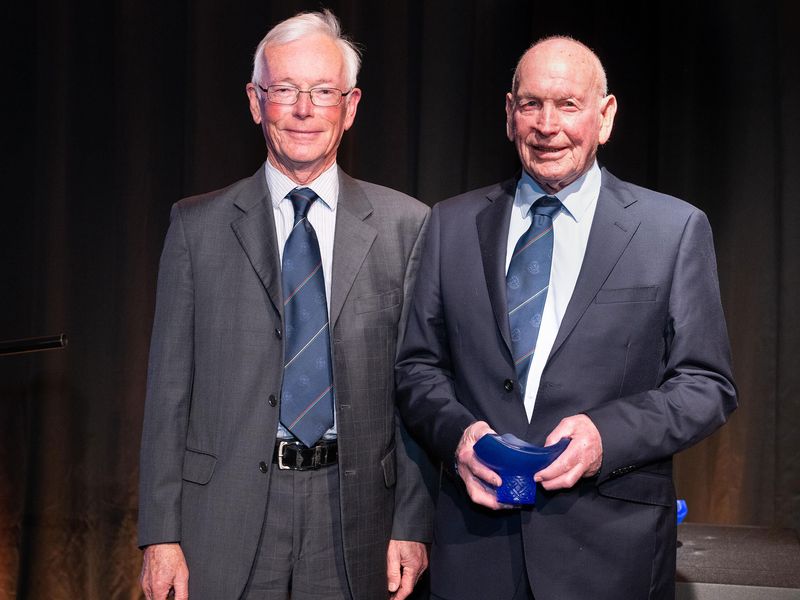
Glen Urquhart was one of the College's foundation students in 1953, with Peter, his brother, following the year after. In those years, the cohorts were small, friendships formed quickly, and many endured. More than half a century on, some continue to meet monthly for morning tea, gather weekly for a pub night, and come together for College events — many still knowing each other by the school numbers assigned back then. They have, quite simply, done life together.
It was a beginning shaped as much by people as by place, shaping qualities of curiosity, determination, and a refusal to accept limitations.
Thrust Into the Deep End
In 1960, still young men, Glen and Peter were thrust into the family business following the loss of their father. Alongside their mother Venus, they took the reins of Coventry Motors — a car sales and service business, including Auckland Rental Cars, founded by their uncle in 1935.
It was an early and defining introduction to responsibility, one that would shape much of what followed.
The Coventry CNG Story
By the early 1970s, the brothers had moved the business from Albert Street in central Auckland to a service station on Wairau Road on Auckland’s North Shore. Around the same time, the development of New Zealand’s Kapuni and Maui gas fields created a national push toward compressed natural gas (CNG) as an alternative fuel.
In theory, CNG held promise. In practice, it was another matter entirely. Compressed gas behaves nothing like petrol. Storage required extreme pressures, vehicles needed modification, refuelling was slow, and there was no clear way to measure what was being dispensed.
Where others saw complexity, the brothers saw opportunity, placing them at the forefront of one of the country’s most ambitious alternative fuel developments.
They tackled two fundamental challenges that limited the use of CNG — how to refill vehicles quickly, and how to measure the gas accurately.
They developed a sequential filling system to reduce refuelling time, maximising both efficiency and usable capacity. Measurement proved more complex. With no existing measuring standard in New Zealand, Peter worked with Auckland University to develop early calculation methods, but precision demanded more. He then sourced and introduced Micro-motion Mass Flow meters, technology which enabled direct and accurate measurement of gas by weight. Technology so new that it was largely unknown in New Zealand at the time.
Accurate measurement changed the operation overnight, bringing clarity, control, and confidence. What had begun as manual valves and pressure gauges evolved into a fully automated, software-controlled system that set a new benchmark for forecourt performance.
That same instinct extended beyond the forecourt. Recognising early the potential of computing, they built and scaled integrated systems, well ahead of their time, supplying customised hardware and software to service stations across New Zealand through Service Station Systems Ltd.
Within a few years, the systems developed at Coventry had matched and then surpassed overseas practice, drawing visits from international fuel company representatives to see firsthand how the operation had been automated and integrated.
It was an era marked by significant progress, but it ended abruptly in 1988 when the oil industry was deregulated. Price controls and licensing were swept away in the hope that competition would lower petrol and diesel prices. Instead, the major oil companies moved quickly to buy up independently owned service stations, including Coventry’s Wairau Road site. With petrol and diesel delivering stronger margins, CNG was quietly stripped out: dispensers removed, equipment taken away, and the infrastructure dismantled. Peter later learned, through a chance conversation, that the change had not been fully thought through—deregulation was meant to apply only to LPG. The long tail of that mistake is still felt: a locally sourced alternative fuel slipped from everyday use and public memory, and New Zealand’s transport energy remained anchored to imported oil.
It was never one breakthrough, or one chapter that defined them. It was a way of thinking. Identify the constraint, build the solution, and keep going.
On the Water and In the Air
The brothers carried that same mindset beyond business.
In the late 1960s and early 1970s, the brothers’ boat Miss Coventry became one of the best-known names on New Zealand’s flat-bottom circuit racing scene. Both brothers raced her, and both won New Zealand Championships. Glen also competed in the 1965 Australian Championships and was leading the race when he sank the boat.
Rather than walk away, they built a second Miss Coventry, sourcing a Ford 427 Cammer engine and rebuilding it to their own specifications, going on to dominate the national circuit. Clocked at 98mph on Lake Karapiro, it reflected not just speed, but the thinking and persistence behind it.
Glen's competitive drive eventually found its highest expression on the world stage. He took on the best at the 1986 World Offshore Powerboat Championship in Guernsey, a gruelling week-long series in the six-litre class, with 27 boats competing from eight countries. He won.
Nearly four decades on, no other New Zealand offshore powerboat driver has claimed a world title. The record still stands.
Glen's world championship title caught the attention of the Malaysian Government, who engaged him to train the helmsmen of their high-speed patrol boats. He ran that programme for 20 years, a relationship that endures today through marine supply brokerage.
For Peter, the sky offered its own arena. He has owned and flown a wide range of aircraft types over more than 50 years, including twin-engined aeroplanes and helicopters. He has made several trips across the Tasman, to Norfolk, Lord Howe, Noumea, Vanuatu and Australia, where he competed in the Bicentennial Around Australia Air Race in 1988, and more recently, fishing trips to the Chatham Islands.
What Endures
From pioneering business ventures to world championships and decades in the air, the Urquhart story covers more ground than most. Through every chapter runs the same thread — a curiosity to understand how things work, a refusal to accept limitations, and the people who have been there through all of it. It has been as much about who was beside them as what they were building.
The morning teas continue. The pub nights continue. And the Urquhart connection to the Saint Kentigern continues into a third generation, with Peter's grandchildren Tom, Matt and Adelaide Sinclair, who also attended the 2025 Alumni Dinner (see image below).
The story, it turns out, is still being written.