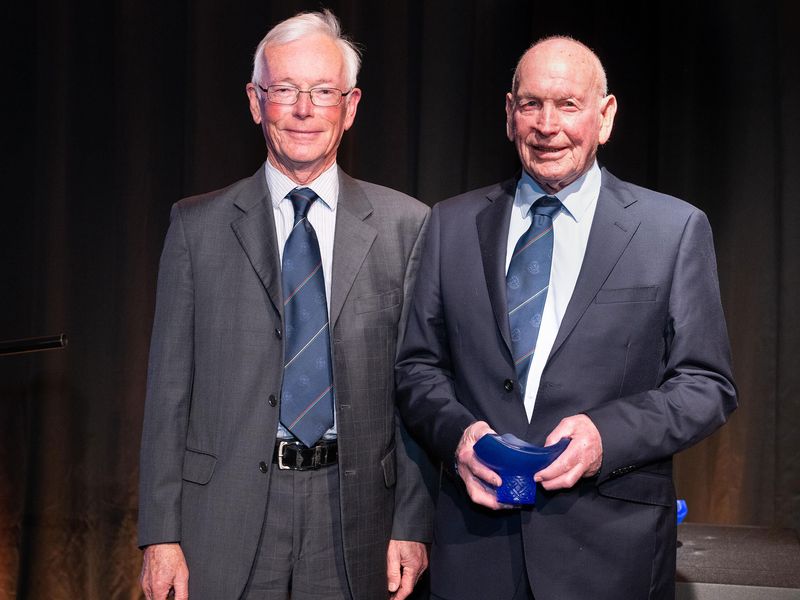





Across five decades, Doug Arcus has helped shape the Waikato’s environmental, educational and philanthropic landscape through law, university governance and public service. Renowned for exceptional judgement and a rare ability to reconcile competing interests, he has influenced decisions and institutions central to the region’s future, earning widespread trust through a leadership style defined by wisdom, collaboration and an unwavering commitment to the public good.
Doug attended Saint Kentigern College from 1955 to 1959, serving as both House and School Prefect. He represented Saint Kentigern in rowing and rugby while pursuing a serious interest in classical music, playing viola in the Auckland Sinfonia and New Zealand National Youth Orchestra.
After completing a Bachelor of Laws at the University of Auckland, Doug returned to the Waikato in 1965. He spearheaded the establishment of the Waikato University Students’ Association and became its first President, beginning a remarkable 13-year tenure on the University Council. After six years as Pro-Chancellor, he became Chancellor at just 37, the youngest university Chancellor in New Zealand’s history. He later served nine years on the University Grants Committee, where he supported founding approval for the Waikato Law School.
Professionally, Doug built a distinguished career in environmental law. After becoming Managing Partner of McCaw Lewis Chapman, he moved to the Independent Bar in 1989 and became a highly sought-after Independent Hearings Commissioner. He helped resolve complex, multi-party environmental disputes and shape landmark planning frameworks for geothermal management, the Lake Taupō catchment and regional water allocation. His measured approach balanced environmental, economic and community interests with fairness and integrity. Across hundreds of determinations, remarkably few of his decisions were challenged or overturned.
Doug’s contribution to the Waikato extended equally into philanthropy. As a Trustee of the D V Bryant Trust for 25 years, including a decade as Chair, he helped guide one of the region’s most significant philanthropic organisations from traditional grant-making towards strategic social investment. During this period, the Trust strengthened its relationships with tangata whenua, supported Te Kōhao Health and the formation of the Waikato Momentum Foundation, while managing a generational transition to ensure its work could continue well into the future.
His longstanding commitment to music and the arts also found expression through service as Chair of Opus Orchestra and leadership of the working group that established Creative Waikato.
Across law, education, philanthropy and the arts, his life’s work reflects uncommon breadth, but also a remarkable consistency of purpose, leaving the Waikato’s landscapes, institutions and communities stronger for his service.